Originally published: February 15, 2017 | Last updated: November 24, 2025
A note on privacy: the protection and security of documents created on our website is critically important. We cannot access information contained in any specific Will. However, we can access aggregated data from an encrypted database that summarizes choices made within our service. We cannot connect this information to individual accounts. It is this data that has been analyzed for this study.
What Is Planned Giving and Why Does It Matter?
Planned giving is the practice of leaving money or assets to a charity through your Last Will and Testament. At USLegalWills.com, we help thousands of Americans create their Wills, and every Will includes the option to make charitable bequests.
According to the National Center for Charitable Statistics, individual giving amounted to $258.51 billion in 2014 — an increase of 7.1% from 2013. Since the 2008 recession, individual giving has been steadily increasing, though it has not fully recovered to pre-recession levels.
Despite this upward trend, research by Russell James shows that only 5–6% of Americans aged 55+ include a charitable estate beneficiary. Approximately 95% of Americans are not including charitable bequests in their Wills. This statistic is partly explained by the fact that roughly half of all Americans do not have a Will at all — no Will means no planned giving.
Why Should You Include a Charitable Bequest in Your Will?
Many people want to give to charity but feel they cannot afford to make significant donations during their lifetime. A charitable bequest solves this problem because:
- The funds are no longer needed — you donate after death, so there is no risk to your financial security
- You can give larger amounts — bequests typically far exceed what people donate during their lifetimes
- Bequests are revocable — a subsequent Will or codicil can cancel a bequest if circumstances change
- They are simple to include — a short paragraph in your Will is all that is needed
- Emotional reward — knowing your estate will do some good provides comfort during your lifetime
How Was This Study Conducted?
These statistics were drawn from over 10,000 Wills created through USLegalWills.com over a one-year period. This is real data from real Wills created by real Americans — not survey results or questionnaire responses.
Important caveats:
- Wills can be updated throughout one’s lifetime, so bequests may be added or removed — these statistics represent a snapshot
- USLegalWills.com is an affordable estate planning service, so very high net worth individuals may be underrepresented
- An Australian study of probate records found no statistical relationship between how a Will is prepared (self-written, online service, or lawyer) and the likelihood of including a charitable bequest
Who Is Including Charitable Bequests in Their Wills?
Our user base is split nearly 50:50 by gender — 44% men and 56% women. In 2015–16, 7.2% of users included a charitable bequest in their Will.
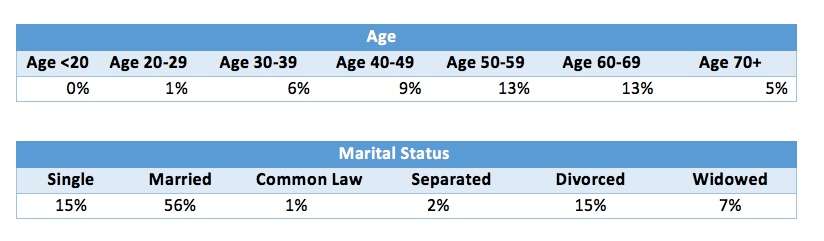
Most charitable bequests go to familiar organizations — local churches, franchise community charities like the Salvation Army, or causes the donor has a personal connection to. Our service prompts users about charitable giving generally but does not promote specific charities, meaning donors must enter charity details themselves.
What Types of Bequests Do People Make?
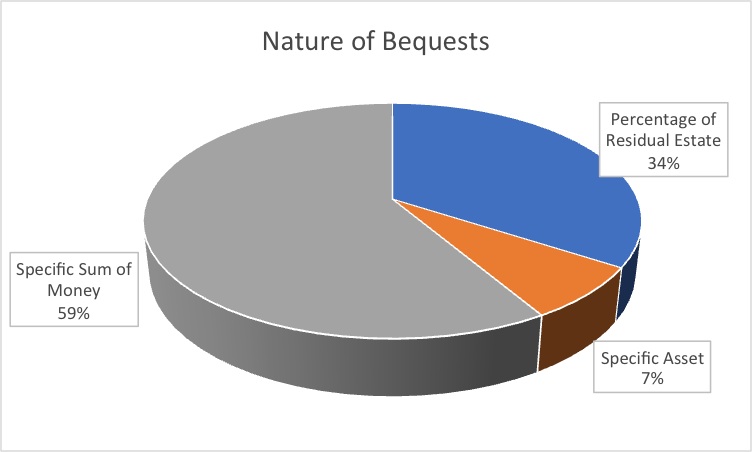
| Bequest Type | Percentage | Example |
|---|---|---|
| Specific dollar amount | 59% | $5,000 to the Salvation Army |
| Percentage of residual estate | 34% | 10% of remaining estate to local church |
| Specific asset | 7% | Painting collection to an art museum |
Which Charitable Sectors Receive the Most Bequests?
We classified charitable bequests into the following sectors:
| Sector | Description | Examples |
|---|---|---|
| Church/Spiritual | All religious denominations and organizations | Local churches, religious leaders |
| Animal | Animal rescue, zoos, humane societies, wildlife | World Wildlife Fund, ASPCA |
| Community | Organizations improving local communities | Salvation Army, United Way, shelters |
| Health | Disease-specific charities | Cancer research, Alzheimer’s, Heart & Stroke |
| Hospital Foundations | Specific hospital fundraising arms | Local hospital foundations |
| Education | Universities, schools, colleges | Alumni donations |
| Environment | Conservation (non-animal) | Greenpeace, Nature Conservancy |
| International Aid | Global humanitarian organizations | World Vision, Oxfam, Doctors Without Borders |
| Arts | Galleries, museums, musical organizations | Local art galleries, choirs |
| Special Interest | Professional bodies, memorial funds, clubs | Hobby groups, societies |
| Politics | Political parties and organizations | Party donations |
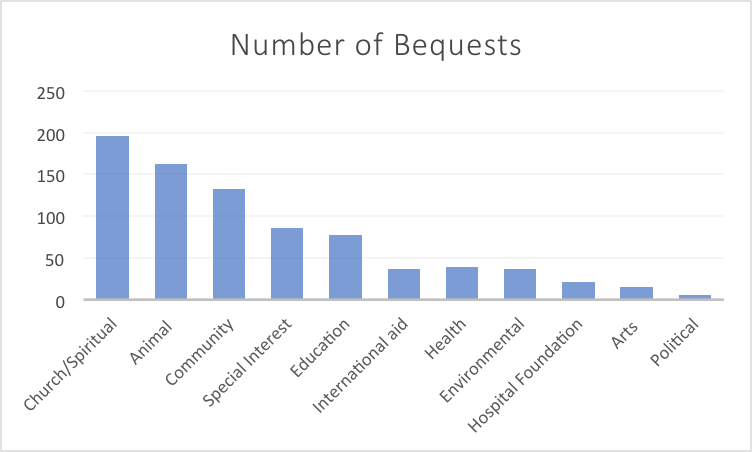
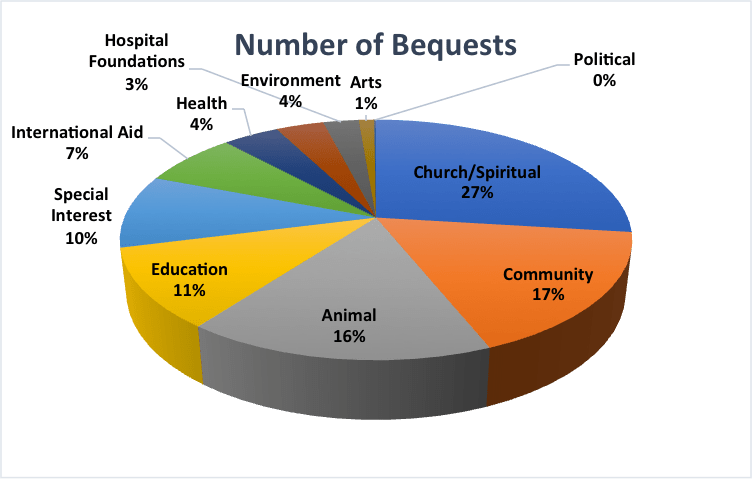
Church/spiritual charities are the most popular beneficiaries of planned giving, followed by animal-related charities. Arts and political organizations receive the smallest number of bequests.
How Much Do People Leave to Charity in Their Wills?
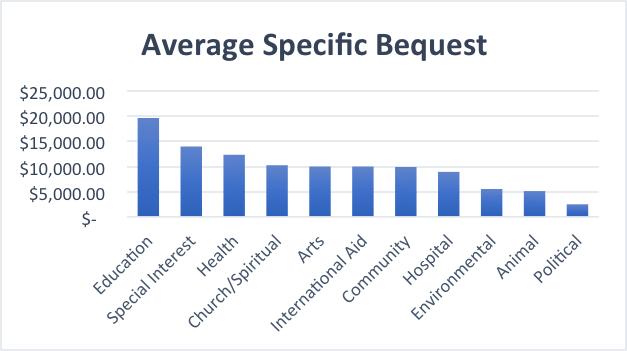
The total mean average charitable bequest given as a specific dollar amount is $9,389.
Average Specific-Dollar Bequests by Sector
| Sector | Average Bequest |
|---|---|
| Education | ~$20,000 |
| Church/Spiritual | ~$10,000 |
| Animal | ~$5,000 |
| Overall Average | $9,389 |
Education receives the highest average donation — likely because alumni commonly donate to their post-secondary institutions, and those donors tend to have higher incomes.
What About Residual Estate Percentages?
Residual estate bequests can represent significant sums. Based on an estimated average residual estate of approximately $340,000, even a small percentage translates to a meaningful gift.
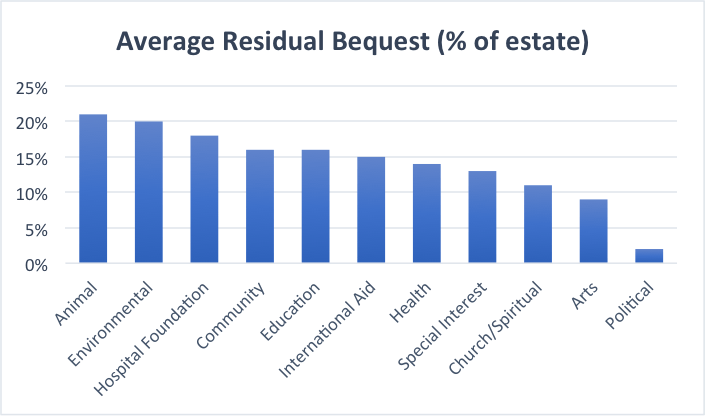
The average percentage of residual estate left to charity across all sectors is approximately 14%, which translates to roughly $47,600.
| Sector | Avg % of Residual Estate | Est. Dollar Value |
|---|---|---|
| Animal | 21% | ~$71,400 |
| Environment | 20% | ~$68,000 |
| Hospital Foundations | 18% | ~$61,200 |
| Arts | 9% | ~$30,600 |
| Politics | 2% | ~$6,800 |
An interesting pattern emerges: animal, environmental, community, and hospital foundation charities receive lower specific-dollar amounts but higher residual estate percentages. This suggests donors to these causes may have lower incomes but allocate a larger share of their estates. Education donors, by contrast, tend to be higher earners who leave smaller percentages that translate to larger absolute amounts.
How Is the Total Value of Charitable Bequests Distributed?
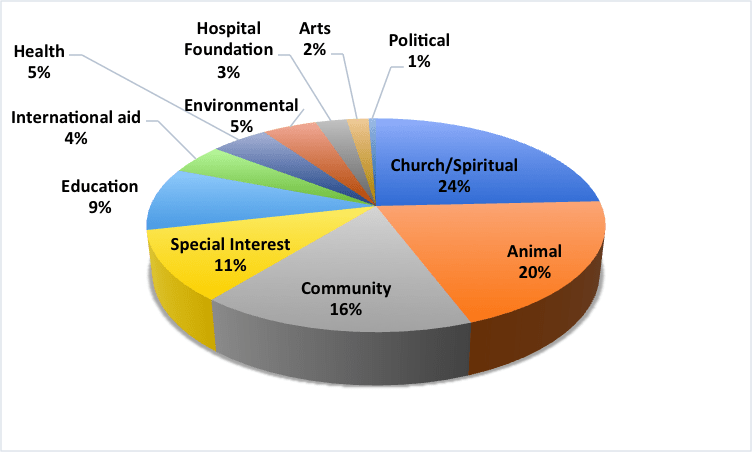
When combining all bequest types (specific amounts, residual percentages, and specific assets), the total distribution across charitable sectors is:
| Sector | Share of Total Value |
|---|---|
| Church/Spiritual | 27% |
| Community | 17% |
| Animal | 16% |
| Health | ~10% |
| Hospital Foundations | ~8% |
| Education | ~7% |
| Environment | ~5% |
| International Aid | ~4% |
| Special Interest | ~3% |
| Arts | ~1% |
| Politics | <1% |
This distribution closely mirrors the number of bequests per category, with only minor variations. Church/spiritual organizations dominate both in frequency and total value of bequests received.
How Can You Include a Charitable Bequest in Your Will?
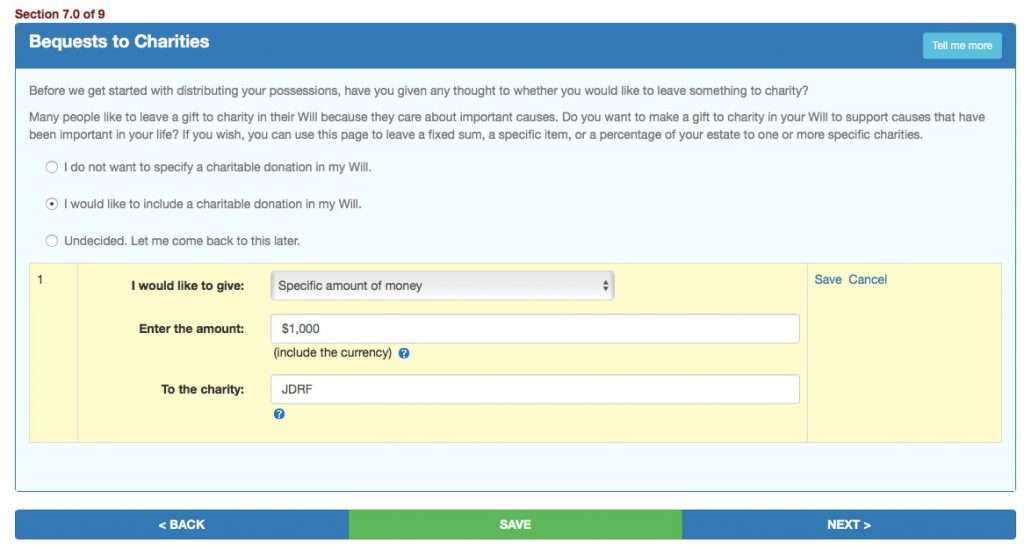
Adding a charitable bequest to your Will is straightforward. At USLegalWills.com, the Will-writing process includes a dedicated page for charitable giving. You can specify:
- A specific dollar amount to one or more charities
- A percentage of your residual estate after other distributions
- A specific asset such as a vehicle, artwork, or collection
Even leaving just 1% of your estate to charity can make a meaningful difference. On a $340,000 estate, that is $3,400 — a significant contribution to any organization.
If you are a charity interested in partnering with USLegalWills.com to promote planned giving, please contact us at [email protected].
Related Articles

He has over 20 years of experience helping people to write their Will and other estate planning documents. He has been interviewed by many of the major news media outlets, and has contributed to articles in The New York Times, NY Metro Parents, U.S. News & World Report, and other leading publications. He has also contributed to a number of financial planning books.
Throughout his career, Tim has written extensively on the subject of Will writing and estate planning.
- Testamentary Trusts – what are they and how are they created? - March 16, 2026
- Every document you need for a complete estate plan. - March 9, 2026
- Estate Planning in troubled times - February 23, 2026