Originally published: September 11, 2019 | Last updated: February 19, 2026
TL;DR: A Last Will and Testament functions as a legal document which directs how your estate will be distributed while allowing you to choose your Executor and child Guardians. All adults need to have one because state intestacy laws take control of their entire estate when they die without a Will. Most legal matters do not require you to obtain a lawyer. Three options exist: handwritten Wills (risky), lawyer-prepared Wills ($800+), and online services like USLegalWills.com ($49.95) that produce the same quality document in about 20 minutes. A Will must be written on paper, signed, and witnessed by two adults.
Table of Contents
What Is a Last Will and Testament?
A Last Will and Testament needs to be created when you have mental capacity so you can define your post-mortem instructions. The document directs how you want your stuff to be divided after you pass away while naming your Executor who will follow your instructions and your children need Guardians until they reach adulthood.

A Will needs to be created through either handwriting or typing and it requires your signature together with a date at the conclusion of the document. The signing process needs two competent adults who have no interest in the Will to serve as witnesses when the document exists as typed text. Some jurisdictions accept an entirely handwritten document (a “holographic” Will ) even without witnesses, but this is generally not recommended under normal circumstances.
Under current law, a Will must be an originally signed piece of paper. Video Wills, electronically signed Wills, and verbal promises are not accepted as legal Wills. The process of accepting Wills through fax or photocopy or scan or digital format becomes possible only when the original document has been proven to have been lost by accident or destroyed.
What Information Goes into a Will?
A well-drafted Last Will and Testament contains several essential components:
| Component | Purpose |
|---|---|
| Declaration | States the document is your Will and identifies you as the testator |
| Revocation clause | Cancels all previous Wills |
| Executor appointment | Names the person responsible for administering your estate |
| Estate distribution | Specific bequests, percentage shares, or equal divisions |
| Guardian appointments | Names who will raise your minor children |
| Contingency clauses | Covers scenarios like beneficiaries predeceasing you |
| Trust provisions | Sets up trusts for young beneficiaries with terms and conditions |
| Executor powers | Defines the limits and scope of the Executor’s authority |
Asset distribution can take several forms:
- Specific bequests: “I leave $10,000 to the Humane Society”
- Specific items: “I leave my Steinway grand piano to my niece Jane Doe”
- Percentage shares: “I leave 10 percent of my estate to St Luke’s Church”
- Equal shares: “I leave my estate in equal shares between my three children”
- Or any combination of these instructions
A well-written Will accounts for every possible scenario – beneficiaries, executors, or guardians predeceasing you, births, marriages, and deaths in your family and in the families of anyone named in the Will. The usual length of a proper Will document consists of four to five pages.
What Does an Executor Do?
The probate court grants Executor authority through its “Grant of Probate” which makes the Executor responsible for:
- Filing the Will with the probate court for acceptance
- The process of collecting all assets which include bank accounts and investments and property and possessions and digital assets requires full protection.
- The property needs protection through lock replacement and property ownership verification
- The process of opening an estate bank account requires you to deposit all financial assets which you have received.
- The Will’s instructions direct how the estate assets should be distributed among the beneficiaries.
For a detailed guide, see our article on what to do when you’re named Executor of a Will .
Is a Will the Same as a Living Will?

No. A Living Will is an unfortunately named document that serves a very different purpose from a Last Will and Testament.
| Feature | Last Will and Testament | Living Will |
|---|---|---|
| When it takes effect | After your death | While alive but incapacitated |
| What it covers | Asset distribution, appointments | Medical treatment decisions |
| Key appointments | Executor, Guardians | Healthcare Proxy/Representative |
| When it ceases | After estate is distributed | At the moment of death |
A Living Will typically includes two parts:
- Healthcare Proxy – appoints a substitute decision maker who can guide physicians on your care if you are in a coma or otherwise incapacitated
- Advance Directives – your expressed wishes for medical treatment in an irreversible terminal condition, including tube feeding, Do Not Resuscitate (DNR) orders, pain medication, and other life-sustaining treatments
For more details, see our article on Living Wills and their definitions.
Do I Need a Last Will and Testament?
Yes. There is no situation where dying without a Last Will and Testament is a preferred course of action. Without a Will:
- Your family must resolve your estate with no direction
- A court-appointed Executor handles everything – not the person you would have chosen
- State “intestate succession” rules determine distribution, which rarely match your real wishes
- Family tensions escalate as different people assert their rights
- Much of the estate can be lost to legal fees
- The process can take months of acrimony

A Will allows you to distribute your estate through purposeful decisions which let you support charitable organizations and create lasting memorials and finance your niece’s school expenses and back your religious institution. Without a Will, these opportunities are lost entirely.
When Should I Write a Will?
You should write your Will as soon as you are an adult and update it throughout your life as circumstances change. You should always have a current Will in place.
Update your Will whenever:
- Your marital status changes (marriage, divorce)
- Children are born or adopted
- Your children become adults and have their own children
- Your Executor becomes unable to serve (illness, relocation)
- Named guardians move overseas or experience significant life changes
- A beneficiary has a windfall or change in circumstances
- Your asset situation changes significantly
Modern online Will writing tools make it much easier to maintain your Will to reflect your current circumstances – you can log in and update in minutes rather than scheduling an expensive lawyer appointment.
How Can I Write a Will?
There are three methods available for creating a Will which offer distinct advantages and disadvantages:
Option 1: Handwrite a Will or Use a Blank-Form Kit
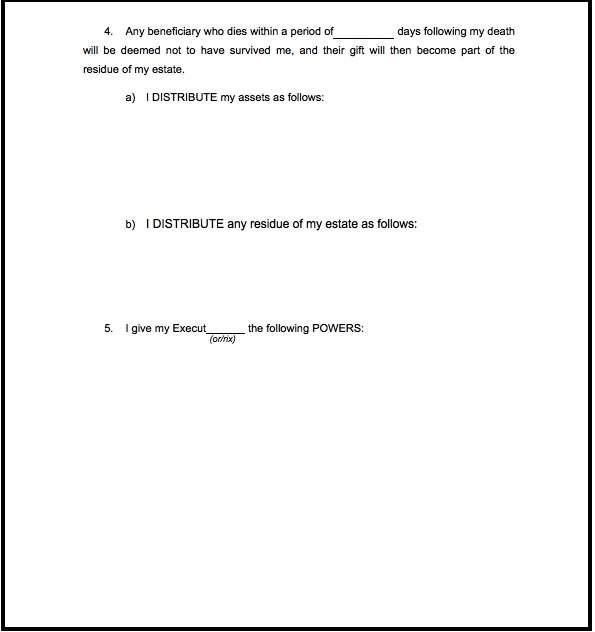
You could literally write on the back of a napkin that you are preparing a Will, that your estate is all going to your spouse, and then sign the document. Most states across the United States require you to create a legal Last Will and Testament. The reason blank-form Will kits exist because they offer a basic structure which includes an introduction and signature area but you need to insert your information.
The problem: these kits are generally a terrible approach to writing a Will and often result in a document that cannot be enforced. Almost all news articles discussing the pitfalls of preparing your own Will are referring to these blank-form kits. The document contains sections which require legal knowledge for completion because ordinary people lack the ability to understand them.
For more on this, read our article on the six most common errors in a DIY Will.
Option 2: Write Your Will with a Lawyer
At the opposite end of the spectrum, an estate planning attorney provides legal advice and tax planning guidance. This is valuable if you have:
- A child with special needs receiving government benefits who needs a special trust
- Doubts about the legal implications of your distribution plan (e.g., disinheriting a spouse)
- A complex estate requiring tax planning strategies
The process of creating a Will through an attorney requires you to pay over $800 for basic services which also creates difficulties. As a professional couple with young children, you need to arrange time off work and childcare to meet at the lawyer’s office, then repeat the process a week later for document signing. The process of updating requires you to spend the same amount of time and money every time you need to make changes. USLegalWills.com receives many customers who want to change their Executor appointment because they received a $500 price quote for this basic service.
Option 3: Use an Online Will Writing Service
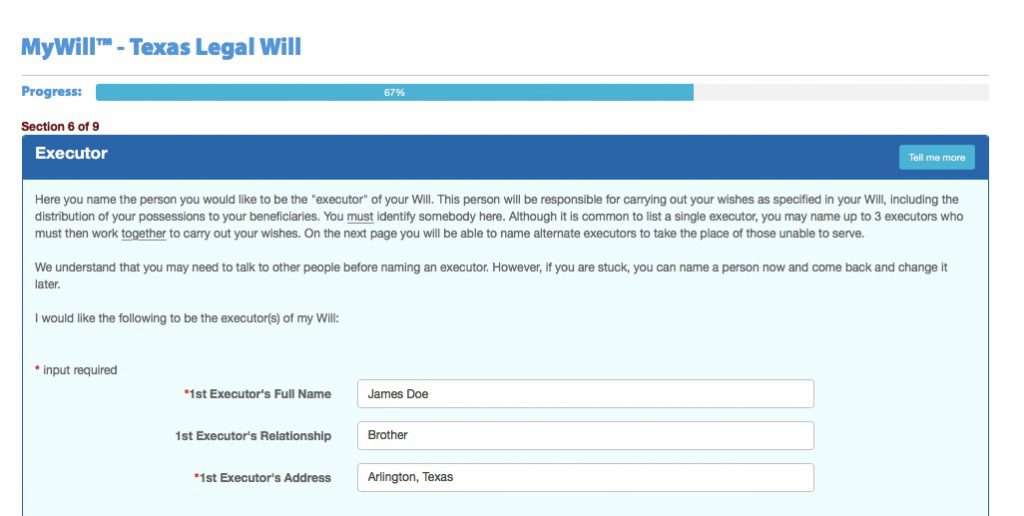
Online Will writing services fill the gap between inadequate blank kits and overpriced lawyers, giving you a professional-grade Last Will and Testament at a do-it-yourself price. These services guide you through the process like tax preparation software – you answer a series of questions, and your document is compiled.
Key advantages of online services:
- Affordable: USLegalWills.com charges $49.95 for a Will
- Convenient: write your Will at any time, from any location – put the children to bed, sit on the sofa with your partner, and complete it in 20 minutes
- Flexible: save your work and continue later; take weeks if you prefer
- Updatable: log in and make changes in minutes as circumstances evolve
- Supported: trained professionals available by phone, email, or live chat
Services like USLegalWills.com have also innovated beyond simple document preparation with complementary tools:
- MyLifeLocker – maintain an inventory of assets for your Executor
- MyVault – upload important files securely
- MyKeyholder – ensures the right information gets to the right people at the right time

Do I Need a Lawyer to Write a Will?
You need a lawyer only if you need legal advice. If you have a straightforward distribution plan – everything to your spouse, then divided between your children, with trusts for minors and guardians named – there is nothing in this scenario that requires a legal opinion. An online Will service handles this comfortably.
Not everyone has enough money to pay for a lawyer and some people live too far away from legal services. But everybody can and should prepare their Will. This is exactly why no state statute requires a lawyer to prepare a Will .
What Is the Best Way to Write a Will Without a Lawyer?
People who create their Will without legal help need to think about three essential elements during their writing process:
| Factor | Blank-Form Kit | Online Will Service |
|---|---|---|
| Cost | Free or cheap | $49.95–$100 |
| State-specific | Rarely | Yes |
| Legally reviewed | Unknown | Yes, signed off by lawyers |
| Support available | No | Phone, email, live chat |
| Kept up-to-date | No | Yes, reflects changes in law |
Write Your Last Will and Testament Today
You should try one of the top online Will writing platforms when you want to create your Will. The process will show you which details should appear in a Will while you might discover the task becomes easier than you expected.
Get Started on Your Will Right Now
Related Articles
- How to Write a Will: Your 10 Step Guide to Success
- Writing Your Will: The Definitive Guide
- The 4 Critical People in Your Last Will and Testament
- How Much Does a Will Cost? And Why?
- Named Executor of a Will: Now What?
- The Holographic Will

He has over 20 years of experience helping people to write their Will and other estate planning documents. He has been interviewed by many of the major news media outlets, and has contributed to articles in The New York Times, NY Metro Parents, U.S. News & World Report, and other leading publications. He has also contributed to a number of financial planning books.
Throughout his career, Tim has written extensively on the subject of Will writing and estate planning.
- Testamentary Trusts – what are they and how are they created? - April 2, 2026
- Every document you need for a complete estate plan. - March 26, 2026
- Estate Planning in troubled times - March 12, 2026